er>
Superfeeding in the aquarium: risks, consequences and what happens (chemistry and biology) when there is more food
Overfeeding is one of the most frequent — and underestimated — causes of instability in domestic aquariums. It is not just about "dirtying the water": the excess of food and organic matter triggers a chain of chemical and biological processes that can compromise the health of fish, the effectiveness of filtration and the balance of the ecosystem.
Why is superfeeding so common?
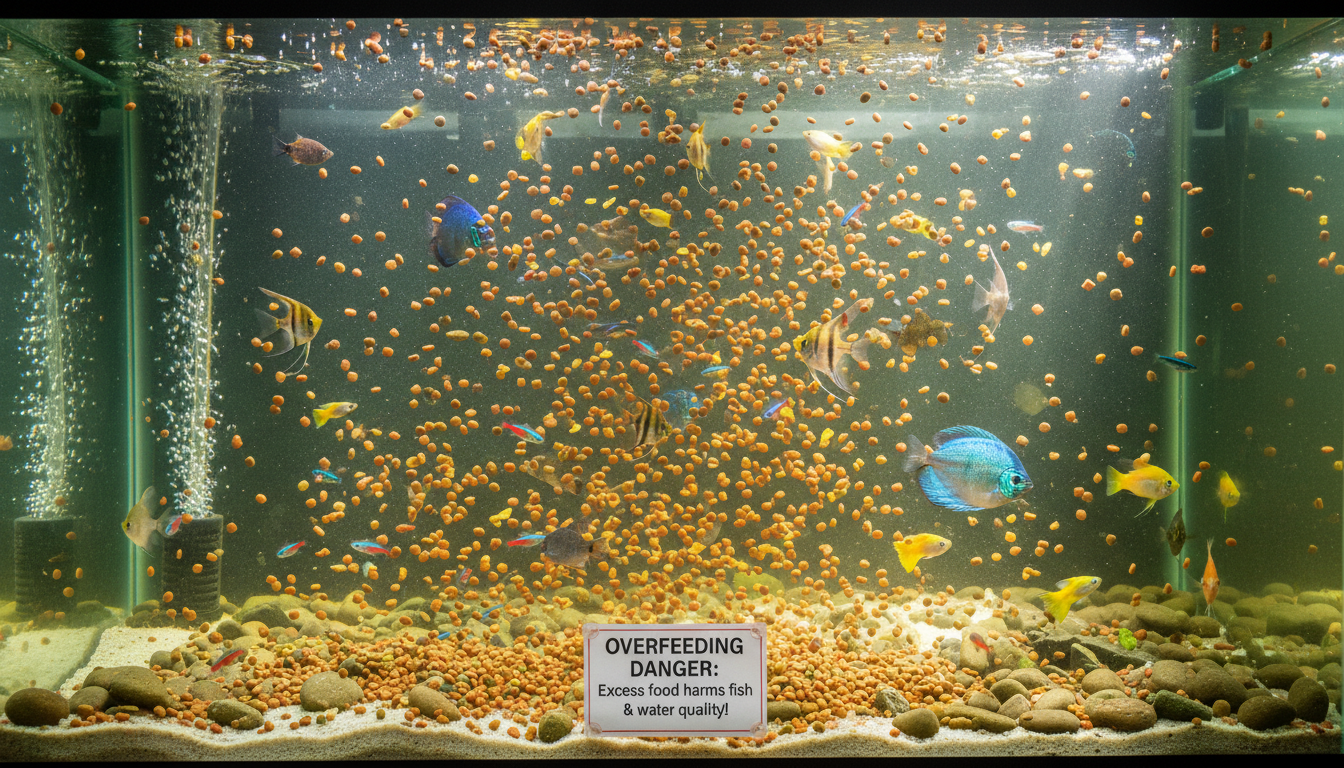
In Aquarius, the environment is a closed system. Almost everything that enters (food) ends up becoming a charge for the biological filter and in nutrients available for microorganisms and algae. In addition, many fish associate the aquarist's presence with food and exhibit "request" behavior that can be confused with real hunger.
The result is typical: "just a little more" becomes a pattern, and the aquarium pays the invoice in the form of ammonia/nitrite spikes, muddy water, algae and chronic stress in animals.
Food constitution: from nutritional value to polluting potential
Fish food (flakes, granules, pellets, frozen or live) is formulated to provide energy and nutrients. However, what is not ingested — and what is ingested but not assimilated — ends up entering the cycle of organic matter and nitrogen in the aquarium.
Main components and implications in the aquarium
- proteins (fish, krill, insects, etc.): essential for growth and maintenance. They are also the main source of nitrogen. The nitrogen excreted by fish (especially via gills) and the nitrogen released by the decomposition of food debris contributes to the formation of ammonia.
- Lipids (fats): concentrated energy source. In excess, they can aggravate digestive problems and increase dissolved organic matter, favoring bacterial blooms.
- carbohydrates: vary widely from formulation to formulation. Species with a naturally carnivorous diet tend to tolerate less excess starch; Leftovers contribute to organic load and cloudiness.
- fiber/vegetable ingredients: fundamental for herbivores and many omnivores. Insufficiency can contribute to constipation and poor intestinal motility; Excess (or leftovers) returns to pollution.
- phosphates: Gifts in ingredients and additives. in excess, they accumulate as dust43−, potentiating algae and cyanobacteria when combined with light and nitrates.
Practical note: Very dense dry foods (granules/pellets) are easy to over-dose. Small "by eye" variations can double the actual amount of food introduced into the aquarium.
Fish needs: what determines how much (and what) to feed
There is no universal rule that fits all species and all aquariums. The need for food depends on:
- species and natural diet (herbivore, omnivorous, carnivore, detritivorous, planctivore).
- size and age: juveniles tend to need smaller and more frequent meals; adults, less frequent.
- Temperature: Metabolism increases with temperature (within the physiological limits of the species).
- Activity Level and feeding behavior (quick species vs. shy/slow).
- Aquarius purpose: Growth/fattening, maintenance, reproduction, low load planted aquarium, etc.
A classic mistake: "they always look hungry"
Many fish (and especially opportunistic species) continue to eat whenever there is food available. This is adaptive in nature, where food is not guaranteed. In Aquarius, this same strategy easily leads to overfeeding and metabolic problems.
Amount to be given: objective criteria and a simple protocol
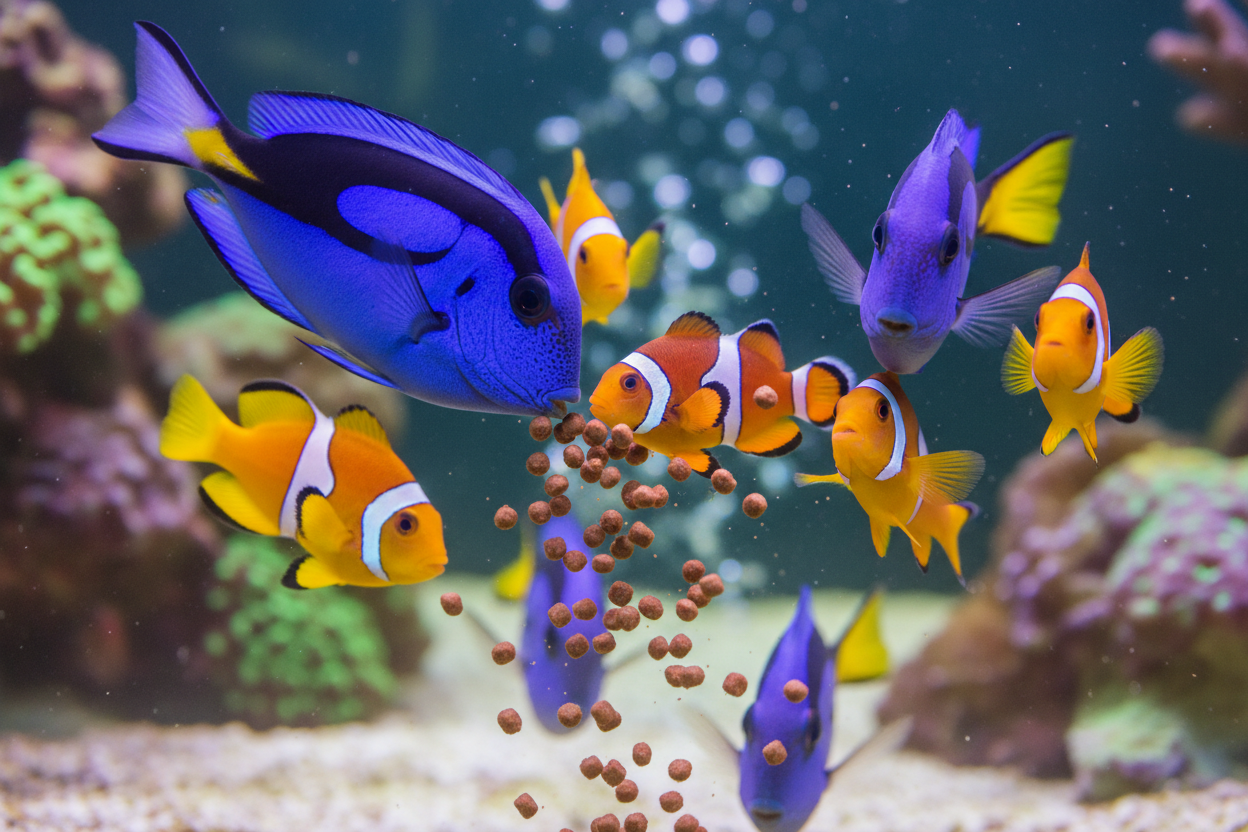
The most reliable method to avoid excesses is to feed based on the aquarium response and not in the human perception of quantity. A good starting point is:
- small portions, observing consumption. Ideally, most of the food should be consumed quickly, without accumulation in the background.
- consumption time as a reference:
- Rapid and mid-water species: typically 30–90 seconds to consume the portion.
- Slow, background, or community aquariums with competition: it can be acceptable until 2–3 minutes, provided they don't over remnants.
- Repeat in micro-portions (instead of a "single dose") when there are shy fish or intense competition.
- monitor parameters (see final section) and adjust the power incrementally, not abruptly.
In many systems, one or two meals a day is sufficient for maintenance. In specific cases (youth, reproduction, species with high metabolism), a greater frequency can be justified — with strictly controlled portions and compatible filtration capacity.
Consequences of superfeeding in fish
Direct impacts (physiology and health)
- Obesity and visceral fat accumulation: reduces longevity and reproductive performance.
- hepatic steatosis (fat liver) in inadequate diet and energy excess contexts.
- constipation and abdominal distension, especially with low fiber diets for species that require it.
- greater production of excreta: more nitrogen and organic matter enter the system.
- chronic stress associated with the gradual degradation of water quality.
Indirect impacts (water quality and pathology)
- branchial irritation by ammonia and nitrites, with rapid breathing and lethargy.
- greater susceptibility opportunistic infections (bacterial and parasitic) when there is stress and instability.
- behavioral changes: Aggressiveness due to food competition, apathy when there is hypoxia, or loss of appetite in toxic peaks.
What happens in the aquarium: chemical reactions and biological processes
Overfeeding increases the entry of Particulate organic matter (remains) and dissolved organic matter. This feeds heterotrophic microorganisms, increases oxygen consumption and overloads the biological filter.
1) Decomposition and increased organic load
Food debris and feces decompose. Heterotrophic bacteria multiply rapidly and can cause cloudy water (bacterial bloom). This process increases the Biochemistry search for oxygen And it can reduce dissolved oxygen, especially at night (when plants also breathe).
2) Ammonia: the first stage of the nitrogen problem
The nitrogen from proteins is transformed by excretion and mineralization into ammonia. Toxicity depends on the balance between non-ionized ammonia (huh3, more toxic) and ammonium (huh4+less toxic), influenced by ph and temperature. At higher pH and higher temperatures, the NH fraction3 tends to increase, raising the risk.
3) nitrification: ammonia → nitrite → nitrate (and alkalinity consumption)
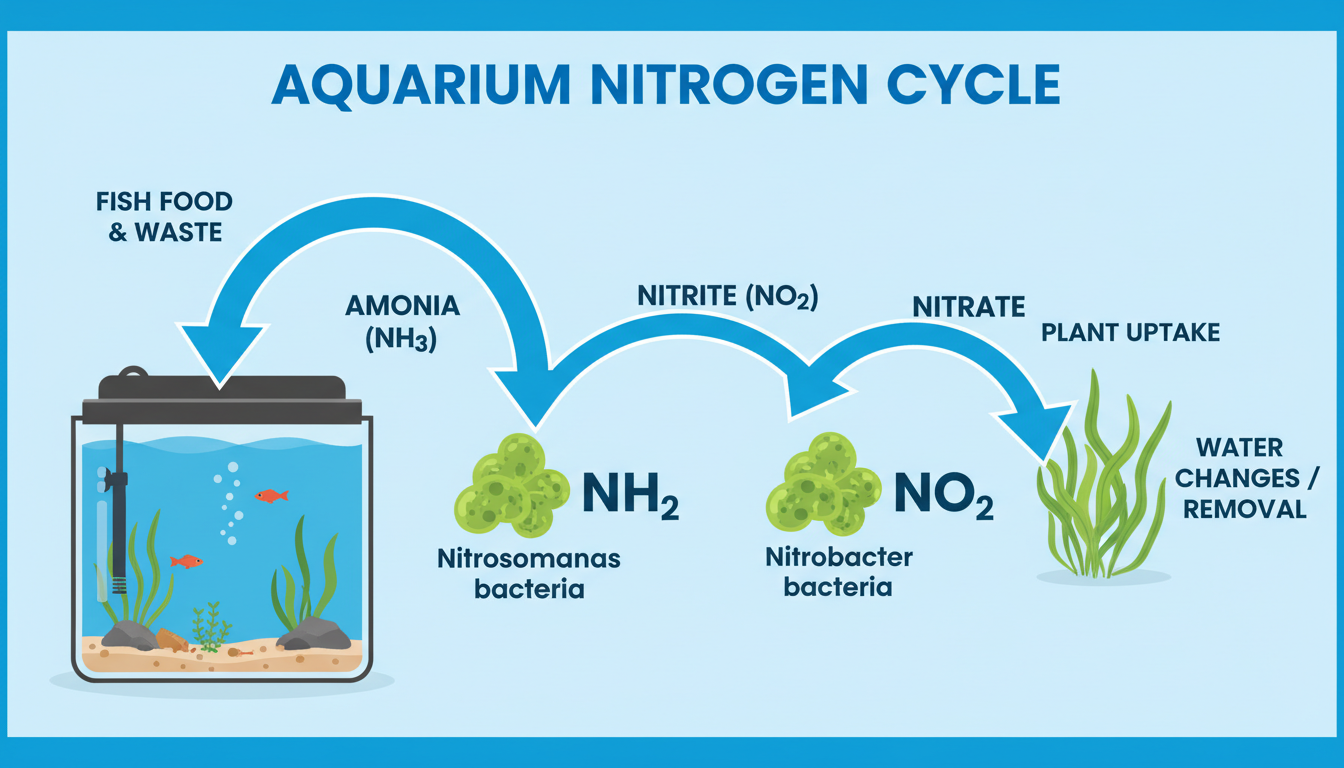
In a cycled aquarium, nitrifying bacteria convert:
Ammonia (NH3/nh4+) → nitrite (intwo−) → nitrate (in3−)
This process is beneficial but costs:
- consumes oxygen (Nitrification is an aerobic process).
- consumes alkalinity (KH), and may contribute to a gradual drop in pH in systems with weak tampon.
- If the organic load increases rapidly, the system may have ammonia spikes and/or nitrite, because the capacity of the biofilter does not accompany the production.
4) Accumulation of nitrates and phosphates: the "fuel" for algae
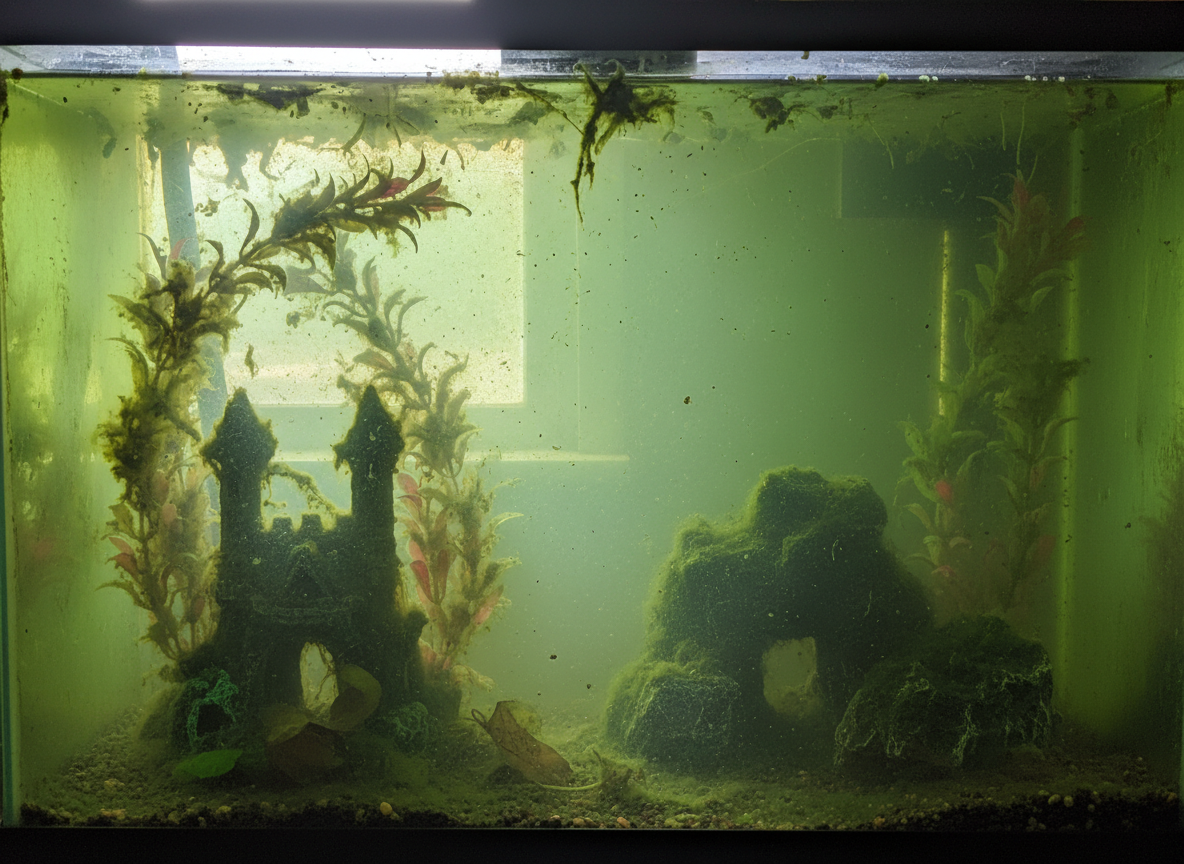
Even when nitrification works well, the end of the line is often the accumulation of In the3− and dust43−. in the presence of light and imbalance (for example, plants with growth limited bytwo or micronutrients), these nutrients favor conferva And in some scenarios, cyanobacteria.
5) Anaerobic zones and undesirable by-products
When debris accumulates in the substrate or in areas with little circulation, micro-zones with low oxygen can form. There, the decomposition follows less efficient pathways and undesirable odors and compounds can arise. It is not an inevitable phenomenon in all aquariums, but the risk increases with excess food, irregular maintenance and poor circulation.
Technical Summary (Chain Chain-Effect)
| excess food | Process | observable effect |
|---|---|---|
| Remains + Feces | heterotrophic decomposition | cloudy water, consumption of Otwo, smell, debris on the bottom |
| More nitrogen in the system | Mineralization → Ammonia | Stress, accelerated breathing, risk of toxicity |
| Biofilter under load | Nitrification | consumption of thetwo, KH/ph drop, peaks of NOtwo− if the capacity is insufficient |
| accumulated nutrients | In the3−/po43− high | Algae, weakened plants if there is imbalance |
Typical signs of overfeeding
- Food visible at the bottom or circulating in the water column after the meal.
- Substrate with persistent debris and "sludge" in low-circulation areas.
- Blurred water with no obvious mechanical cause (especially after meals).
- Increase in algae and superficial film.
- Tests to indicate an uptake of ammonia/nitrites or persistently high nitrates.
- Fish with distended abdomen, long/gelatinous stools, apathy or panting breathing.
What to do if you suspect overfeeding (fixed without "shocks")
1) Immediate feed adjustment
- reduces the portion and starts to feed on micro-doses.
- Removes leftovers after the meal (network/siphon), especially in small aquariums.
- Considers lighter feeding days (depending on species and body condition).
2) Maintenance focused on removing organic matter
- siphoning debris accumulated in the substrate and dead corners.
- Clean pre-filters/mechanical sponges more often (without sterilizing the biofilter).
- Improve circulation/oxygenation, especially if there is turbidity or signs of hypoxia.
3) Monitoring of parameters
In correction phases, it is worth measuring regularly: huh3/nh4+, In thetwo−, In the3−, ph And when possible, kh.
The reading of the tests should guide the intensity of the water changes and the rate of feeding. If there is ammonia or detectable nitrites in a supposedly cycled aquarium, a risk situation is assumed and the priority is to stabilize the system.
Conclusion
Feeding well is not feeding too much. It is to align the diet with the species, respect the animal's metabolism and, above all, maintain the balance of the system: less accumulated organic matter, biofiltration to work within its capacity, stable oxygen and controlled nutrients. Consistency — not generosity — is what keeps a predictable and healthy aquarium.


