
Alga BBA (Black Beard / Black Brush): Complete Technical Guide — Identification, Causes, Treatment and Prevention
The BBA is a dark “brush/beard” appearance, strongly adherent to leaves, hardscape and equipment. In practice, effective control is always double: fix the cause reduce biomass stabilize the system. Treating only “over the top” tends to result in recurrence.
1) What is BBA (and why it is so persistent)
“BBA” is the most used designation in the hobby for black beard algae / black brush algae. Visually, it manifests as short tufts dark (black/grey/dark brown) with brush/brush, adhering with high force to hard surfaces and stricter leaves.
The reason why it is considered “difficult” is not a “magic power”, but the combination of:
- strong adhesion (Does not come off easily by light scraping).
- Colonization of critical surfaces (Filter outputs, diffusers, trunks, rocks, slow leaves).
- Ability to leverage instability: When plants oscillate (carbon/light/nutrients), BBA gains a competitive window.
- partial treatments They leave “reservoirs” (spores/fragments) that restart the cycle if the cause persists.
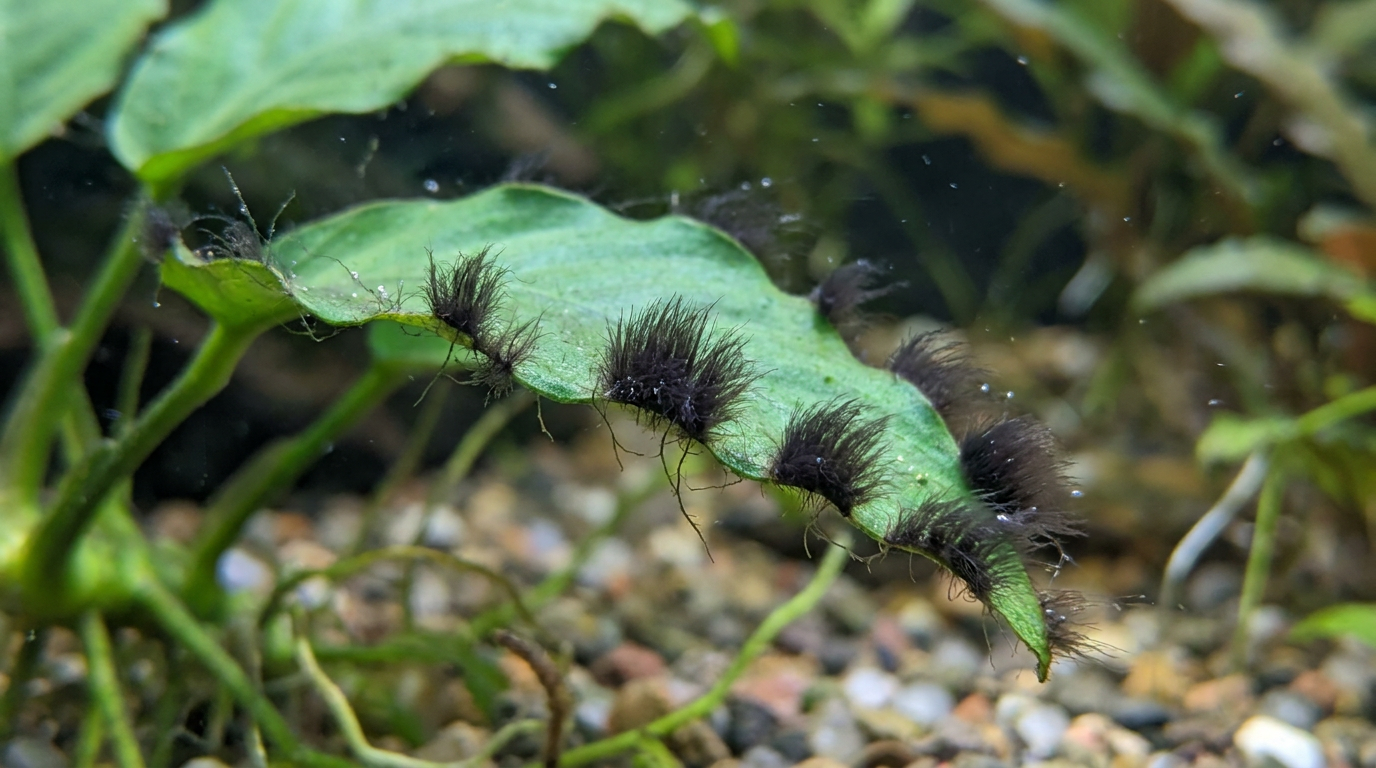
Image reference: Original image generated by AI for editorial use (Hydra Fertilizers), 2026-05-05. URL: https://cdn.abacus.ai/images/38946760-27b5-4cc4-88ed-346cf4d9869c.png
2) Identification: typical signs and differential diagnosis
2.1 Classic BBA signs
- Morphology: short “brush” type tuft, not a long “hair” type.
- Color: black/grey/dark brown; Sometimes it can look dark green in intense light.
- Fixation: “grabbed” — try to pull and it doesn't come in “novel”; part or get stuck.
- Location: Hardscape + Equipment + Slow Growth Leaves (and zones with unstable conditions).
2.2 Where it usually appears first (standard that helps to diagnose)
- trunks/rocks (especially rough surfaces).
- Filter outputs and Lily Pipes.
- Diffusers/reactors, tubing and micro-bubble zones.
- Old leaves and damaged margins.
- in equipment: Indicates that the water “carries” the favorable conditions (instability/organic load).
- In slow sheets: Indicates reduced plant competition (plants are not dominating).
- In Hardscape: Indicates persistent reservoir (if not removed, resets foci).
2.3 Differential diagnosis (not to treat “the wrong target”)
| Suspicion | typical appearance | practical test | common mistake |
|---|---|---|---|
| baby | Brush dark short tuft | does not roll; is firmly adhered | “Kill” without correcting cause → recurrence |
| filamentous (hair) | green long wires | Easily roll up a toothpick/tweezer | confuse and exaggerate spot treatment |
| staghorn | Branched filaments (horn type/street) | form visible branches | treat like “dust”/debris |
| Biofilm/Debris | brown film or dust | Leaves with siphoning/light brush | Ignore organic (root cause) |
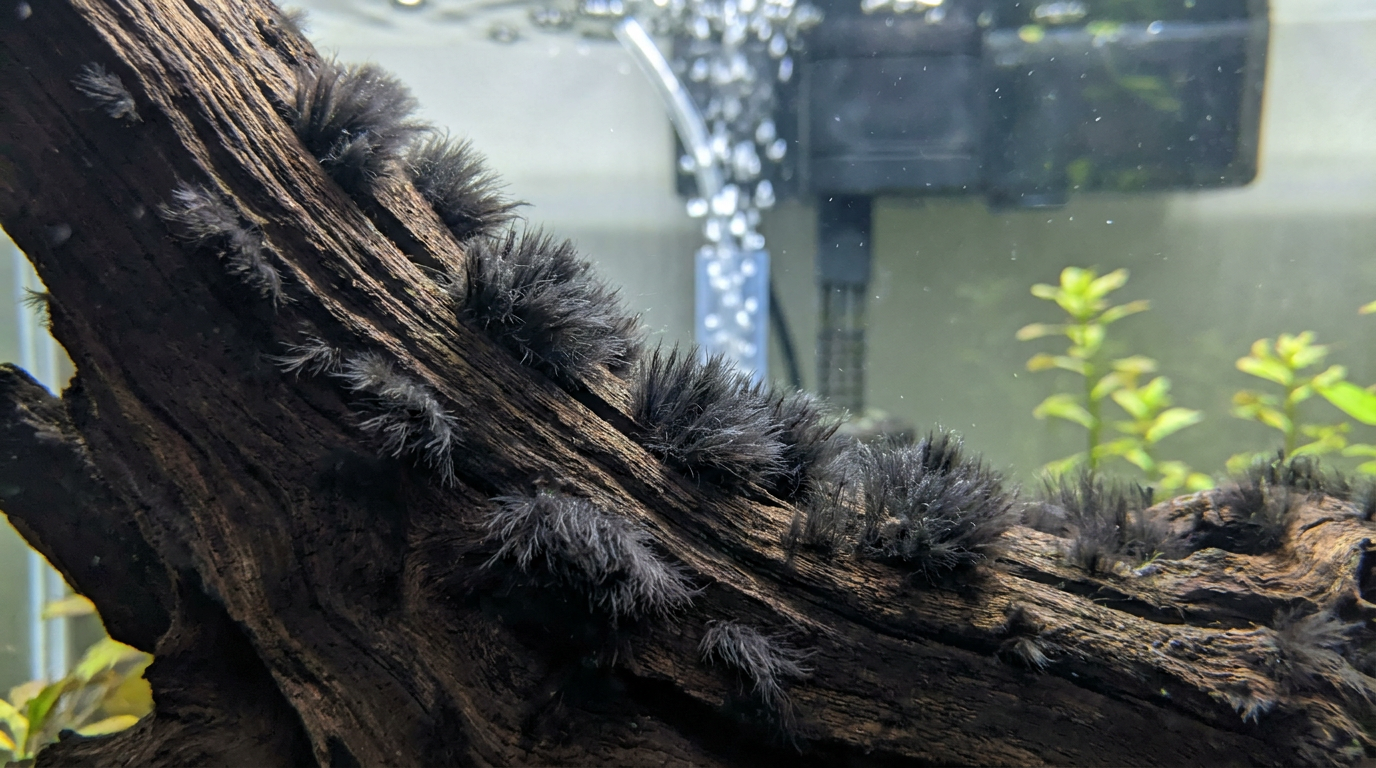
Image reference: Original image generated by AI for editorial use (Hydra Fertilizers), 2026-05-05. URL: https://cdn.abacus.ai/images/7fc70c09-d8fd-41f1-8aba-e778c010be58.png
3) Biology and behavior in the aquarium (adhesion, propagation and “hot spots”)
3.1 Why “glue” so much?
In the aquarium, BBA develops as a set of short and dense filaments that are fixed to micro-irregularities of the surfaces. This makes mechanical removal incomplete (superficial scraping) often insufficient: “roots/fragments” are stuck and the focus recovers.
3.2 How to “spread” in practice
On a day-to-day basis, scattering occurs by:
- Spores/Propagules in the water column (especially when the focus is disturbed and fragments are released).
- passive transfer (plants, hardscape, nets, scissors, hoses).
- Invisible Reservoirs on equipment (tubes, diffusers, filter rotor, Lily Pipes).
3.3 The “gold standard” to solve
It resolves when the plants start to grow stable and predictable (high competition) and the BBA no longer has a window of advantage. Removal/spot treatment speeds up the process, but system stability is what closes the cycle.
4) Most likely causes: causal model (carbon, flow, light, nutrients and organic)
In planted aquariums, BBA is rarely “excess X” isolated. The typical scenario is instability + weakened plant + reservoir. Below, a technical model (useful to diagnose without guessing).
4.1 Unstable available carbon (CO₂) — the most frequent trigger in high-tech setups
When the available carbon oscillates throughout the day (peaks and breaks), plants change their metabolic rhythm and lose consistency. This “oscillation” can be caused by aggressive adjustments, wrong timings (on/off), inefficient diffusion, or uneven distribution.
- indirect signs: Irregular growth, weak new leaves, the appearance of algae on slow leaves and hardscape.
- Common error: Increase too fast (greater instability) instead of gradually stabilizing.
4.2 Circulation and distribution (useful flow ≠ “current”)
“having flow” is not the same as distribute co₂ and nutrients homogeneously. BBA tends to appear in patterns that report:
- dead zones (detritus accumulation + low water renewal).
- direct jet on surfaces (microenvironments with strong gas exchange and stress on leaves).
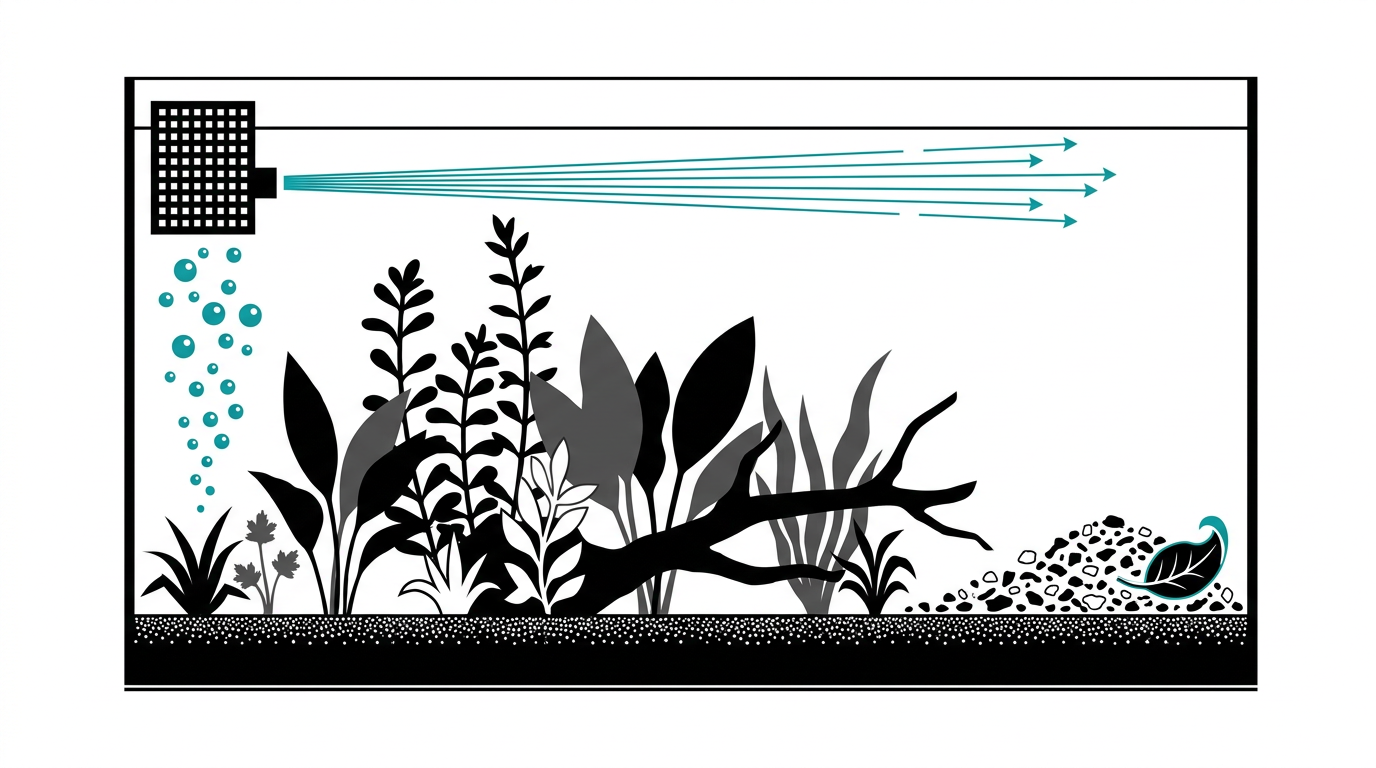
Image reference: Original illustration generated by AI for editorial use (Hydra Fertilizers), 2026-05-05. URL: https://cdn.abacus.ai/images/a01125ae-8720-4f8b-a97f-4c4b1460ea18.png
4.3 Light “in front” of the system
Light is an accelerator. If the light (intensity + hours) is above the capacity of: Carbon + nutrients + stability, the aquarium enters algae regimen.
- Classic sign: BBA and other algae increase after light upgrade without recalibration of the rest of the system.
- Technical note: More light increases the demand for carbon and nutrients; If these do not accompany, the plant “failure” and algae take advantage.
4.4 Nutrients: excess, deficit and above all “inconsistency”
The most common mistake is to think “algae = excess fertilization” and cut everything. In many cases this gets worse: plants stop, lose competition and algae persist in the reservoirs. The technical approach is:
- Avoid prolonged zeros (zero limiting nutrients for several days) in aquariums with high light.
- Avoid aggressive peaks (irregular doses that create “mountains and valleys”).
- Ensure that macro and micro are aligned with the vegetable mass and photoperiod.
4.5 Organic load (debris, mulm, food, degrading leaves) and saturated filtration
The accumulation of organics creates microenvironments with greater availability of substrates for biofilms, bacteria and opportunistic algae. In addition, saturated filters:
- reduce real flow (worst distribution).
- retain organic matter (slow release).
- They increase “hot spots” in the circuit itself (tubes, rotor, sponges).
Instabilidade (CO₂/fluxo) + luz forte + plantas lentas + orgânicos → Competitive Window → Fixed BBA → Reservoir → Recurrence.
5) Technical diagnosis in 10–20 minutes (practical checklist)
Identify The limiting factor (which is preventing the plant from dominating) and the reservoir (where BBA is surviving).
5.1 “Quick and surgical” checklist
- photoperiod: How many hours? Was there recent change?
- CO₂ Routine (If applicable): Calls in advance enough? Is it stable until the end of the light period?
- Distribution: Are there areas without movement where the detritus easily rests?
- FILTER FLOW: Has fallen in the last few weeks? Lily Pipes/Diffusers are partially obstructed?
- Substrate and Hardscape: Is there a accumulation of mulm in corners and behind rocks/trunks?
- Maintenance: Regular TPA? Consistent mechanical cleaning?
- building documents: New growth is healthy? Are there old “undo” leaves?
- reservoirs: Tubing/Diffuser/Filter output with “beard” = Active focus of the system.
5.2 Signs that point directly to the cause (interpretation)
| what do you see | what do you suggest | Priority Correction |
|---|---|---|
| BBA mainly in Anubias/Buce + Hardscape | Slow plants are not competing; persistent reservoir | Removal + General Stabilization + Reduce Stress |
| BBA appears after changing light (stronger/more hours) | Light ahead of the system | Reduce photoperiod/intensity + rebalance carbon/nutrients |
| BBA in Tubing/Diffuser/Filter Output | Reservoir in the circuit + water “Loads” favorable conditions | Circuit cleaning + stabilize parameters |
| BBA in stopped debris zones | Organic + Dead Zone | Siphoning + flow redistribution + maintenance routine |
6) Complete treatment (step-by-step) — from quick control to resolution
Any “chemical” intervention (eg oxidants, aldehydes, DIPs) must respect the product label, the sensitivity of the fauna/flora and the reality of your aquarium. In case of doubt, opt for mechanical removal and correctness of cause — these are the measures with the best effectiveness/risk ratio.
6.1 Step 1 — Reduce biomass (which is already there)
- strategic pruning: Removes very infested leaves (especially old leaves from slow plants).
- Brushing/Scraping: Hardscape and glass; then aspirates so as not to spread fragments.
- equipment cleaning: Lily pipes, diffusers, tubing and filter outputs (the “reservoir” is often here).
- siphoning: Removes accumulated detritus in corners and behind the hardscape.
6.2 Step 2 — Stabilize the system (where most fail)
This step is what determines whether the BBA returns or not. Adjusts gradually and consistently:
- CO₂ (if you use it): prioritizes daily stability and good distribution; It avoids sudden changes “from one day to the next”.
- Flow: Eliminates dead zones and prevents jets from “hitting” directly on leaves; seeks homogeneous circulation.
- Light: Temporarily reduces the photoperiod during the acute phase (and then only goes up when the system is stable).
- nutrients: Avoid total cuts; The goal is consistency and plants to grow.
- organic: Maintenance routine (TPA + mechanical cleaning) until the water “seats” and the debris stops accumulating.
6.3 Step 3 — Localized treatment (spot treatment) when necessary
In persistent focuses (especially hardscape and equipment), the Spot Treatment can speed up greatly. The logic is to directly reach the BBA, avoiding exposing the entire aquarium to a high concentration.
- good practices:
- stop circulation for a short period /5min) to avoid immediate dispersion.
- Apply hydra carbon with syringe/pipete only in focus.
- resume circulation.
- what to observe: The BBA tends to lose color and “define” over the course of days, it will be made in the water without the need for direct removal.
6.4 Step 4 — Biological support (help, does not replace the correctness of cause)
"waste eaters" such as hydra bioclean They can help consume waste and maintain cleaner surfaces, it is a product with live bacteria that will consume these debris and organic matter, but rarely eliminate BBA alone if the cause remains. The technical rule is: first reduce biomass and stabilize, then use the cleaning team as a maintenance support.

Image reference: Original illustration generated by AI for editorial use (Hydra Fertilizers), 2026-05-05. URL: https://cdn.abacus.ai/images/599038c0-ad7f-4214-9a50-013a1ff83f90.png
6.5 14-day practical plan (realistic and efficient)
| Time course | Goal | actions |
|---|---|---|
| days 1–2 | Break the “Volume” | Mechanical removal/pruning + equipment cleaning + siphoning + TPA |
| days 3–7 | Stabilize | Gradual CO₂/Flux adjustments + Reduce photoperiod + Maintain consistent routine |
| days 5–10 | Eliminate persistent focuses | Spot treatment in hardscape/equipment (with prudence) + waste vacuuming |
| days 8–14 | Consolidate and prevent recurrence | Filter Maintenance (if necessary) + TPA + Strengthen plant growth (without spikes) |
It's not "disappearing everything in 24 hours". It is the progressive reduction in the capacity of BBA to regain terrain, accompanied by more stable plant growth and lower accumulation of organics.
7) Protocols by scenario (which changes according to your aquarium)
7.1 Low-tech aquarium (without CO₂ pressurized)
- Priority 1: Reduce light (hours and/or intensity) to align with naturally available carbon.
- Priority 2: Maintenance of organics (TPA + siphoning + filter) to remove “fuel”.
- Priority 3: increase plant mass and favor fast-growing plants (real competition).
- What to avoid: Irregular fertilization in peaks and “total cuts” that stop the plants.
7.2 High-tech aquarium (CO₂ + strong light)
- Priority 1: Stability and CO₂ distribution throughout the light period.
- Priority 2: homogeneous flow (eliminate dead zones and direct jets in leaves).
- Priority 3: Consistent fertilization (avoid oscillations and marked limitations).
- Useful tools: Circuit cleaning + spot treatment in persistent reservoirs.
7.3 BBA in Anubias / Bucephalandra / Fettos (slow plants)
- Fearless pruning (when necessary): Infested old leaves are reservoirs.
- repositioning: Prevents direct jets and areas with stopped debris.
- Focus on Stability: These plants do not “shoot” growth to compete; depend on the aquarium being stable.
7.4 BBA in Hardscape (trunks and rocks)
- Brushing + aspiration: Removes as much physical as possible (reduces the reigning load).
- spot treatment It can be especially effective in hardscape, as long as it does not replace systemic corrections.
- Check the flow: Hardscape creates shadows and dead zones; It is common for the problem to “born” behind rocks.
7.5 BBA on equipment (tubes, Lily Pipes, Diffusers)
- It treats as “symptom” and “reservoir” at the same time: If you ignore it, it reintroduces foci.
- routine: Periodic circuit cleaning + Maintain a stable actual flow filter.
- If you return quickly: There is instability in the aquarium (it is not “just dirt”).
8) Prevention and maintenance: how to prevent return
8.1 Prevention principles (those that really work)
- Consistency (Light, CO₂, fertilization and maintenance with a fixed routine).
- Distribution (Useful and homogeneous flow, without dead zones).
- organic hygiene (Detritus is an “indirect food” for persistent problems).
- plants to grow (Real competition; Stopped Plants are “Open Door”).
8.2 Recommended routine (simple and effective model)
| frequency | Task | technical objective |
|---|---|---|
| Weekly | TPA + light siphoning in accumulation zones | Reduce organic and stabilize the water column |
| Weekly | Pruning/removing old leaves | Eliminate reservoirs and reduce decomposition |
| fortnightly/monthly (according to load) | Cleaning the filter mechanic (without “sterilizing” everything) | Maintain real flow and reduce saturation |
| Monthly (or when needed) | Tubing cleaning/diffusers/outputs | Eliminate persistent reservoirs |
“Clearing too much” can also create instability. The ideal is consistent and moderate maintenance, focused on removing excess organic and maintaining the flow/efficiency of the system.
9) FAQ (Frequently Asked Questions)
Is BBA toxic for fish and shrimp?
In general, the problem is above all aesthetic and competition (suffocates leaves and reduces plant efficiency). The greater risk is usually indirect: unstable aquarium → plants weaken → organic increase → algae persist.
If I “kill” the BBA, does it go out alone?
The overwhelming majority of the time it loses color and “undoes” over time, but dead outbreaks can be adhered to.
Why do you always come back after 2–3 weeks?
Almost always because the systemic cause continues: instability (carbon/flow/light), or organic and reservoirs in the equipment. If it comes back quickly, it treats it as a “stability alarm”, not as “bad luck”.
What is more important: reduce light or increase CO₂?
Depends on your type of aquarium. Technical Rule: If you have high light, the system requires carbon and stability; If you can't provide/stabilize, reducing light is the safest lever. In high-tech, stabilizing CO₂ and distribution is usually decisive.
What is the most reliable sign that I am winning the battle?
Healthy and predictable new growth in plants + less accumulated debris + less “new points” of BBA. Aesthetics improves as a consequence.


